
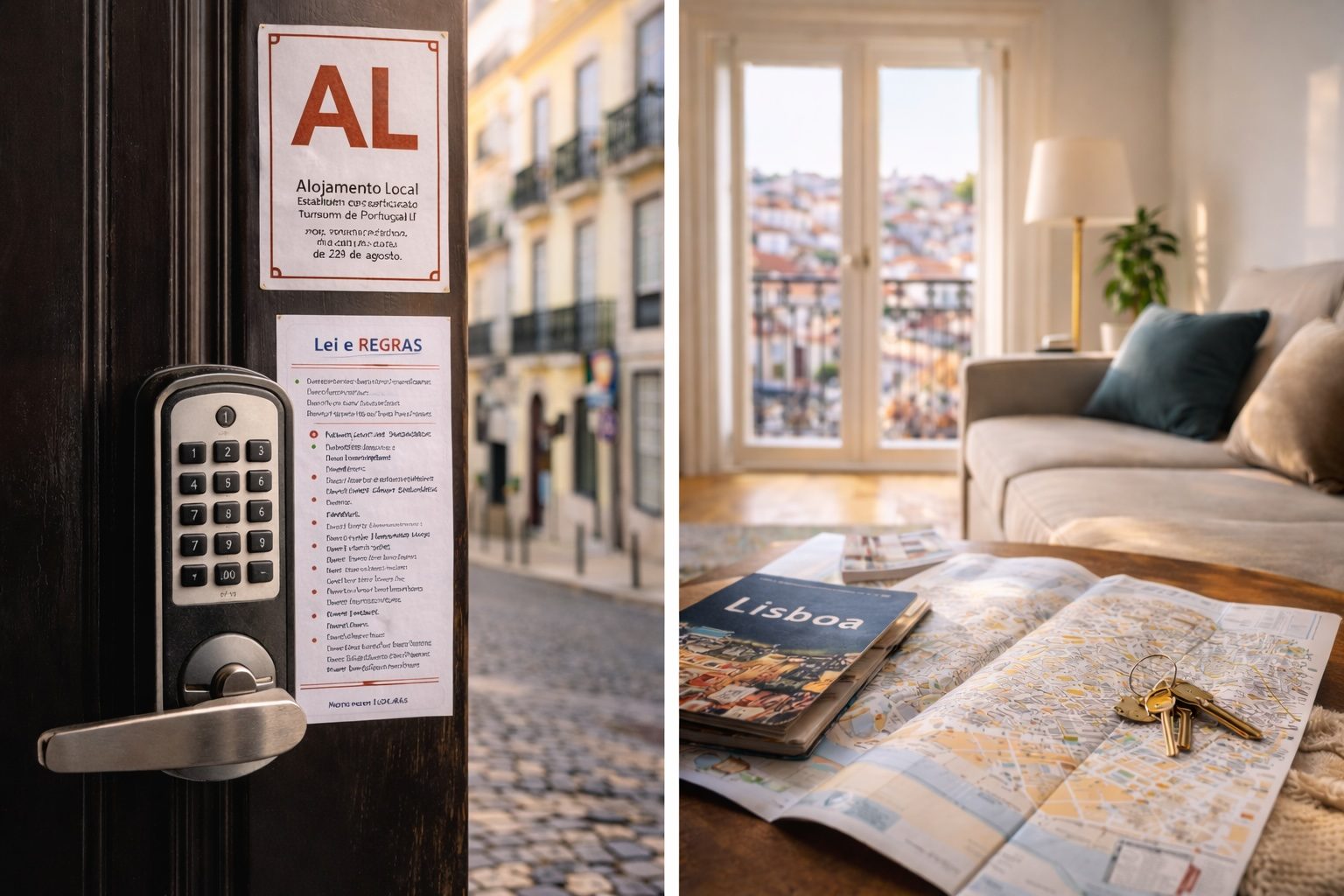
No — you cannot assume that every property in Portugal can legally operate as Airbnb or short-term rental accommodation. Buying a property in Portugal does not automatically grant the right to use it for short-term rental income.
Eligibility depends on the municipality, the building, the property’s classification, condominium rules, and current local regulations. Before buying any property in Portugal with the intention of operating it as Airbnb, the specific property’s short-term-rental eligibility must be verified — not assumed.
This is one of the most common misunderstandings among foreign buyers, and one of the most expensive ones to get wrong. The reasoning seems intuitive: Portugal is tourism-friendly, short-term rentals are everywhere, Airbnb is a major market, therefore if you buy a property you can Airbnb it. Each of those observations is true individually. The conclusion is not.
This article explains why, what matters, and what to verify before you sign anything — written from what we see in practice, not from a legal textbook. For anything specific to your situation, a local lawyer and someone actively working the market at the moment of purchase will give you the accurate answer.
What Airbnb is called in Portugal: Alojamento Local
In Portugal, short-term rental operations are governed by the Alojamento Local (AL) framework. AL is the legal category under which holiday rentals, Airbnb-style lettings, guesthouses, and other short-term tourist accommodation operate. For a property to legally host short-term guests, it needs to be properly registered as AL — and that registration depends on meeting specific requirements at the time of application.
Crucially, AL eligibility is tied to the property and its classification, not just to the owner or to the fact that people want to stay there. A property that is registered as residential may not be eligible for AL registration in a given moment or location. A property in one building may qualify while an apparently similar property next door does not. This is what trips up foreign buyers who assume Portuguese tourism demand automatically equals Portuguese short-term rental rights.
Why not every property can Airbnb
There are several reasons why a property may not be suitable — or legally able — to operate as a short-term rental. Most purchase disappointments trace back to one of four categories.
1. Municipal restrictions
Some Portuguese municipalities apply restrictions on new AL registrations in specific zones or neighbourhoods — typically in areas under heavy tourism pressure or where residential housing stock is under strain. These restrictions have been applied, adjusted, expanded, and in some cases rolled back at various points in recent years, and they vary considerably from one municipality to another. The specific status in any given neighbourhood, at the moment you are buying, is something that must be actively verified rather than assumed.
A property in what you remember as “a good Airbnb area” from a trip three years ago may now sit inside a zone where new AL registrations are not being accepted. Or the reverse: an area you dismissed as too restrictive may have seen rules change. The only reliable answer is a current one.
2. Building and condominium issues
Even where a municipality would issue an AL licence, the building itself can create limitations. Condominium rules (the building’s governing document, known as the título constitutivo), specific clauses in building statutes, or decisions taken by the condominium assembly can restrict or prohibit short-term rentals within that particular building. Neighbour disputes are also a real and recurring factor — the legal position of an owner wishing to Airbnb a unit against co-owners who object is more nuanced than many buyers realise.
This is why reviewing the condominium’s governing documents and recent assembly minutes is essential before buying any apartment for short-term rental purposes. It takes your lawyer an hour; it can save you a year of disputes.
3. Property classification
How the property is legally registered matters. Not every unit is identical from a licensing perspective. Commercial-category units, properties with specific use restrictions in their registration, properties that have been converted but not re-registered, properties in buildings with particular classifications — all of these can have different AL eligibility even when they look identical on a listing site. This is something your lawyer needs to confirm during due diligence, well before the CPCV is signed. Our guide to the CPCV covers why this due diligence stage matters so much.
4. Regulatory change
Portugal has adjusted short-term rental rules multiple times in recent years, and may do so again. What is permissible today may be restricted tomorrow; what was suspended last year may have been partially reopened. Buyers relying on a specific regulatory interpretation need to verify it is current at the moment of purchase, not at the moment of the last article they read online.
Not sure which route applies to you? Portugal Compass points you to it in a couple of minutes — find your route →
Lisbon and Porto — the buyer reality
Many overseas buyers target Lisbon or Porto assuming these are the best Airbnb markets in Portugal. On raw tourism demand that’s often true — both cities see enormous visitor numbers and strong nightly rates for well-positioned properties. But the same tourism pressure that makes them attractive as rental markets is precisely what has made them the most heavily regulated and contested.
In practice, Lisbon and Porto tend to be the most complex cities in Portugal for short-term rentals — not the least. Licensing sensitivity is highest here. Competition is fiercest. Condominium tensions around Airbnb are most common. Regulatory attention is most concentrated. None of this means Lisbon or Porto cannot be excellent markets for the right property — but buying purely on the city’s name without granular verification of the specific property’s eligibility is exactly how surprises happen.
Other Portuguese markets — parts of the Algarve, some coastal towns, selected secondary cities — can sometimes offer more straightforward paths to an operating short-term rental, though each has its own specifics. “Easier regulatory environment” and “better investment return” are not always the same thing; they need to be evaluated together. If the Lisbon vs Porto question is part of what you’re still deciding, our comparison of Lisbon vs Porto for property buyers lays out the lifestyle, pricing and investment trade-offs in detail.
Can you buy first and apply later?
Technically, in some scenarios, you can. Practically, it’s a risk structure we don’t recommend, and one we actively steer clients away from.
The problem is straightforward: if you buy a property expecting to Airbnb it, and after closing discover that the licence cannot be obtained — because of municipal restrictions, building rules, or a classification issue — you own a property that doesn’t do what you bought it for. Your options at that point are to operate as a long-term rental (usually at materially lower yield than projected), use it personally (if that was a viable secondary plan), or sell at a loss of time and transaction costs. None of those are the outcome anyone wanted.
Smart buyers assess short-term rental potential before committing, not after. The CPCV is the wrong moment to start asking questions the answers to which change whether you should have bought the property at all.
What foreign buyers often assume
Four assumptions account for the vast majority of Airbnb-related disappointments we see in practice. All four are usually wrong.
“It’s already on Airbnb, so I’m safe.”
Not always enough. A property currently operating as Airbnb may be doing so under a licence whose carry-over on sale depends on the municipality, a classification that may not survive the sale, or an arrangement that is less solid than it appears. The fact that a unit has an Airbnb listing today is an indicator, not a guarantee. Always verify the legal basis of the operation before relying on it.
“The agent said it can rent short-term.”
The selling agent is incentivised to close the deal. That doesn’t mean they’re being deceptive, but it does mean their statement about AL eligibility is not a substitute for independent verification by your lawyer or an advisor representing you. Ask for the documentation, not just the reassurance.
“Portugal is tourism-friendly, so it’s easy.”
Tourism demand and short-term rental licensing rules are not the same thing. Portugal welcomes tourists enthusiastically; that does not mean every property can legally host them. These are separate questions with separate answers.
“I’ll figure it out after closing.”
Too late can become expensive. The cost of verification before signing is trivial (an hour of legal time). The cost of discovering a problem after ownership transfer can be enormous — a year of projected income at a minimum, sometimes the entire investment case for the property.
Is Airbnb still worth it in Portugal?
Sometimes, yes — for the right property, in the right location, with the right operational approach. Portuguese tourism demand remains strong, average nightly rates in well-positioned areas are solid, and professionally-run short-term rental properties can generate attractive returns compared with long-term letting.
But success depends on a combination of factors, not just any one of them:
- Legal ability to operate — AL eligibility, building permissions, classification.
- Location — within the city, within the street, not just the city itself.
- Building suitability — is it a building where short-term rental works operationally and socially, or one that will create friction?
- Competition — how saturated is the local market at your price point?
- Level of furnishing and presentation — rental-ready, photo-ready, guest-ready is different from “liveable.”
- Management quality — the gap between a well-managed property and a self-managed-from-abroad one is typically 20–40% in revenue.
- Seasonality realism — the Algarve in August is not the Algarve in November. Annual averages matter more than peak-season optimism.
- Guest demand in your specific micro-market — not aggregate Portuguese tourism numbers.
The best Airbnb property is not always the prettiest property — it’s the one whose combination of all these factors adds up to a sustainable business, not a beautiful photograph.
Better alternatives some buyers overlook
One of the most useful services an independent advisor provides is simply asking: “Are you sure Airbnb is the right strategy here?” For properties where AL eligibility is uncertain, where competition is fierce, or where the owner’s personal use plans conflict with short-term rental demands, other strategies sometimes produce stronger and more stable returns.
- Long-term rentals — lower gross yield but meaningfully lower operational demands, regulatory exposure, and void risk. For the right property, long-term can net out better than Airbnb after accounting for management, turnover, and seasonality.
- Mid-term rentals (weeks to months, typically furnished) — often bridge the gap, combining attractive yields with lower regulatory friction than AL-dependent short-term rentals. Growing demand from professionals on assignment, digital nomads, and medical tourists.
- Hybrid personal-use and rental — using the property yourself for part of the year and renting for the rest. This needs careful structuring for tax and practical reasons but can be the best fit for lifestyle-plus-income buyers.
- Premium seasonal strategy — renting only during high season at premium rates, leaving shoulder and off-season periods for personal use or maintenance. Requires a property where peak-season revenue alone justifies the strategy.
Smart investors compare options rather than chase the Airbnb headline. We’ve seen plenty of cases where the “lower” long-term or mid-term yield turned out to be higher net return, once realistic management costs and void periods were baked in. Running the numbers for your specific property, rather than using generic Airbnb projections, is the whole game.
How to buy for Airbnb more safely
If short-term rental income is part of your investment case, six practical steps remove most of the downside:
- Check current municipal rules for the specific neighbourhood, through a local professional who knows what applies this month — not an article written last year.
- Understand building realities — review the condominium’s governing documents, recent assembly minutes, and any history of disputes over short-term rentals in that specific building.
- Review property documentation for classification, existing registrations, and any use restrictions that might affect AL eligibility.
- Verify legal setup before signing — your lawyer should confirm AL status or path to AL as part of CPCV-stage due diligence, not after ownership transfer.
- Analyse the numbers conservatively — model realistic occupancy, realistic average daily rates for your specific sub-market, and realistic management costs. If the property still works on conservative numbers, the upside is free; if it only works on optimistic numbers, you’re buying a hope.
- Consider management logistics — who runs it, how, and at what cost? A beautifully-located property managed badly will underperform a mediocre property managed professionally.
Local Portugal nuance
The answer to “can this property be Airbnb?” can vary not only by city but by neighbourhood, building, classification, and timing. Two apartments on the same street can have different answers. Two properties in the same building can have different answers. The same property can have a different answer in different years. This is why generic internet advice — including, frankly, this article at a level of detail — is incomplete for any specific purchase decision.
The only reliable answer is a current one, for a specific property, from someone actively working the market. That’s not a sales pitch — it’s a structural feature of how short-term rental regulation works in Portugal, and it’s why professional verification at the purchase stage is not optional for serious Airbnb-oriented buyers.
The smarter question to ask
So, can you Airbnb any property in Portugal? No. And assuming yes can be an expensive mistake.
The smarter question to ask is: which properties can realistically and legally perform well as short-term rentals for my specific goals and budget? That’s a different conversation entirely — one that starts with the end in mind (what kind of operation you’re trying to run), works backwards through location, licensing, building, competition, and numbers, and arrives at a shortlist of properties where the answer is “yes, this works” rather than “maybe, if…”.
That shortlist, filtered properly, is usually much shorter than what generic property portals suggest. It’s also dramatically safer. Buyers who approach short-term rental investment in Portugal this way — goals-first, verification-first — tend to end up with properties they’re still happy with three years later. Buyers who approach it the other way round, chasing listings first and asking licensing questions after, tend to have the stories you hear at Portuguese expat dinners.
If you’re considering buying for Airbnb or broader investment purposes, our guide to the hidden costs of buying property in Portugal is a useful companion read — because the full investment case depends on the full cost picture, not just the nightly rate projection. And the broader process is covered in our 2026 complete guide to buying property in Portugal as a foreigner.