
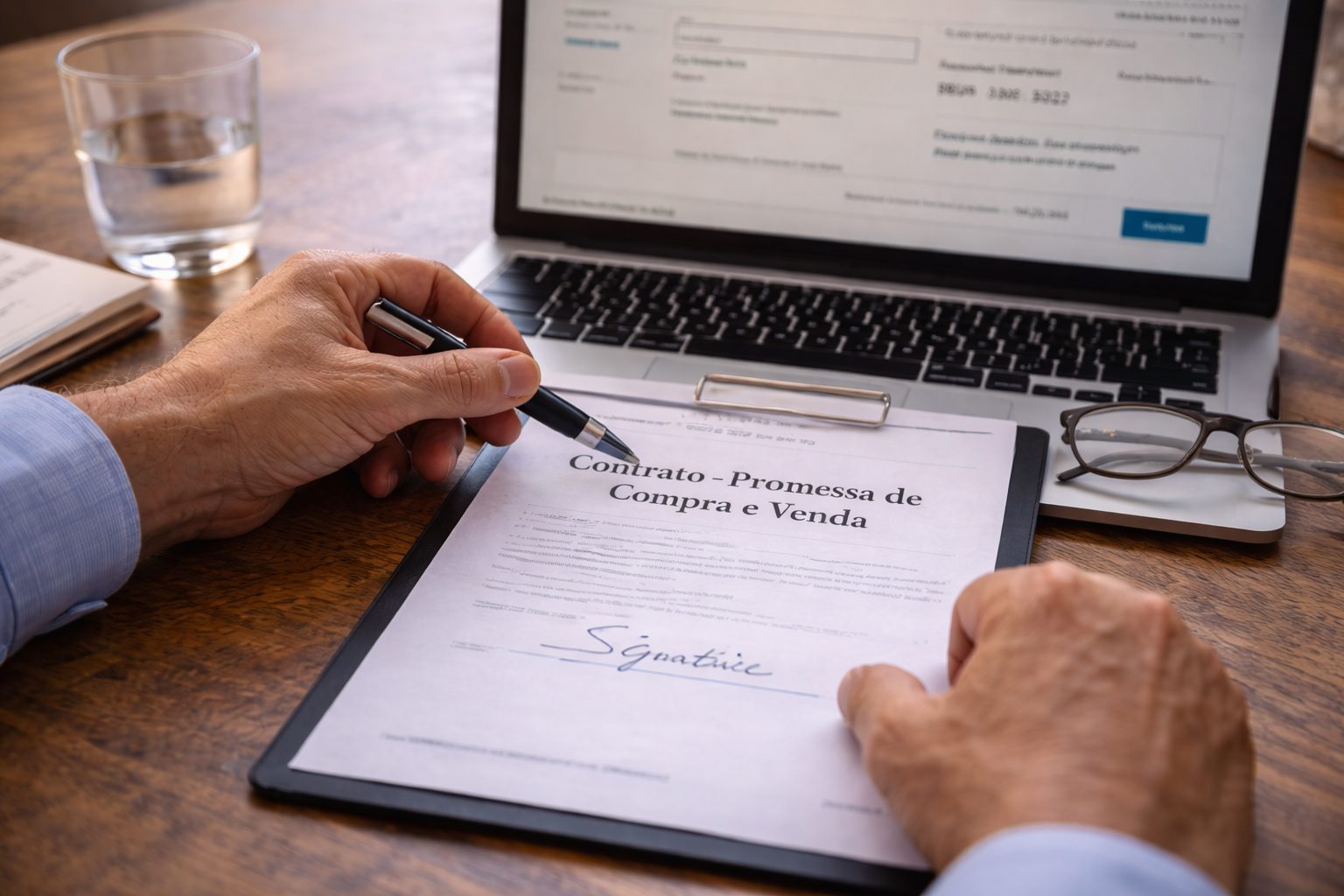
A CPCV (Contrato-Promessa de Compra e Venda) is Portugal’s promissory property contract. It’s signed after an offer is accepted and before the final deed, and at this stage the buyer typically pays a deposit of around 10–20% of the purchase price. Both parties commit legally to completing the sale under agreed terms.
If you are buying property in Portugal, the CPCV is one of the most important contractual moments in the entire process — and it deserves far more attention than most foreign buyers give it.
What does CPCV mean?
CPCV stands for Contrato-Promessa de Compra e Venda, which translates into English as “Promissory Purchase and Sale Contract”. It is a standard feature of Portuguese property transactions — not an optional extra, not a formality, and not simply a “reservation agreement” of the kind you might encounter in other markets.
Many foreign buyers arriving in Portugal assume the final deed (the Escritura) is the only moment of real legal significance, and that everything before it is non-binding negotiation. This is not how the Portuguese system works. In Portugal, the CPCV is where the real legal commitment begins. The final deed is still the moment ownership actually transfers, but by the time you get there, both you and the seller are already legally bound to the deal.
When does the CPCV happen?
The CPCV sits in the middle of the Portuguese property purchase process. The typical sequence:
- Property selected and visited
- Offer made and accepted
- Lawyer reviews property documentation (ownership, licences, registrations, debts)
- CPCV drafted, reviewed, negotiated and signed — deposit paid
- Time passes while any remaining steps complete (mortgage finalising, specific conditions being met, coordinating schedules)
- Final deed (Escritura) signed at the notary — balance paid, ownership transfers
The gap between CPCV and final deed varies. A cash purchase with straightforward paperwork can complete within a few weeks. A purchase involving a Portuguese mortgage for a foreign buyer often runs six to twelve weeks between CPCV and Escritura. Complex renovations, probate issues on the seller’s side, or bureaucratic delays can stretch it further. The timeline itself is one of the things negotiated and fixed in the CPCV. For the broader view of how the whole purchase unfolds end-to-end, our realistic timeline for buying property in Portugal walks through every stage.
Not sure which route applies to you? Portugal Compass points you to it in a couple of minutes — find your route →
What happens when you sign
When the CPCV is signed, several things become legally fixed at once:
- The buyer pays a deposit — typically 10–20% of the purchase price.
- The purchase price is locked in. Neither party can unilaterally adjust it later.
- A deadline for the final deed is set. Both parties commit to completing by this date.
- Key conditions are documented. Anything specific to this transaction — repairs before completion, specific items included, mortgage dependencies, planning approvals — is written into the contract.
- The consequences of default are established. What happens if the buyer doesn’t complete. What happens if the seller doesn’t complete. These are not abstract clauses — they are the teeth of the contract.
From the moment both signatures are on the CPCV, neither party can simply walk away without consequence. That’s not a bad thing — it’s what makes the contract useful to both sides. But it does mean that everything in the CPCV matters. Terms that look standard deserve to be read. Deadlines that look generous deserve to be reality-checked. Conditions that look harmless deserve a second read from a lawyer who’s seen these contracts go wrong.
How much is the deposit?
The most common CPCV deposit is 10% of the purchase price. For a €500,000 property, that’s €50,000 released on signing, with the remaining €450,000 paid at the final deed.
That said, the deposit is negotiable. We have seen deposits as low as 5% on transactions with short gaps between CPCV and deed, and as high as 20% (or occasionally more) in situations with long deed delays, sellers seeking stronger buyer commitment, or new-build properties where staged payments apply. The factors that tend to move the deposit up or down:
- Time until final deed. Longer gaps tend to mean higher deposits, because the seller is carrying the property off-market for longer.
- Mortgage contingencies. A CPCV that depends on mortgage approval may come with a lower or structured deposit.
- Negotiating leverage. A well-positioned buyer can often negotiate the deposit down.
- New-build or off-plan purchases. These often involve multiple staged payments between reservation, CPCV, construction milestones and final deed.
The deposit is paid to the seller, usually by bank transfer on the day of CPCV signing. It is not held in escrow by a neutral third party the way some Anglo-Saxon systems work — the seller receives it directly. This is one of the reasons the CPCV’s default clauses matter so much: they are, in effect, what protects your deposit.
Why the CPCV matters so much
In some countries, buyers rely heavily on escrow systems, lengthy contingency periods, or mortgage contingencies that effectively let them walk away from deals without significant penalty. Portugal is different. The CPCV is not a “soft” agreement you can revisit — it is a binding contract with real financial consequences on both sides.
What this means in practical terms:
- If you sign and then change your mind, you are not simply losing a small reservation fee — you are potentially losing 10–20% of the property’s price.
- If the seller signs and then receives a higher offer from someone else, they cannot simply accept it — not without serious compensation to you.
- Timing commitments are real. Missing the agreed deed date without legal justification can trigger default consequences.
- Conditions you didn’t negotiate into the CPCV are not default protections. If you wanted the seller to fix a roof issue before completion, it needs to be in the contract. If you wanted specific furniture included, it needs to be in the contract. If you want your deposit protected in specific circumstances, those need to be in the contract.
The CPCV is not a formality before the final deed. It is the moment both parties commit — financially, legally, and in practice — to the deal. Treat it accordingly.
What should be in a CPCV?
A well-drafted CPCV typically includes:
- Full identification of both parties (buyer and seller — names, tax numbers, residency status)
- Complete identification of the property (address, registration number at the Land Registry, tax article at the Finance authority, description)
- The agreed purchase price
- The deposit amount and payment terms
- The deadline for the final deed (Escritura)
- Any specific conditions agreed between the parties — fittings included, works to be completed, documents to be produced, approvals to be obtained
- The consequences of default for both parties
- How the remaining balance will be paid at the final deed
- Any special clauses relevant to the transaction (mortgage contingencies, condominium approvals, licensing verifications, etc.)
What’s in a contract matters less than what’s not in it. Every transaction has its own specific issues, and the CPCV is where those get addressed. A generic template CPCV that doesn’t reflect the particular circumstances of your purchase is a weaker document than one drafted with your specific situation in mind.
What happens if someone pulls out
This is where Portuguese property law has a clear default framework — which the CPCV can either follow or modify. The standard rule under Portuguese law:
| Who defaults | Standard consequence |
|---|---|
| Buyer defaults without legal justification | Seller keeps the deposit. |
| Seller defaults without legal justification | Seller owes the buyer double the deposit (the original deposit returned plus an equal amount as compensation). |
This default framework, known as the sinal principle, is one of the most important features of Portuguese property law for foreign buyers to understand. It makes the deposit a real stake in the transaction — not just a gesture of good faith, but an enforceable commitment with symmetric consequences for both parties.
However, the CPCV can modify these defaults. Specific clauses may define other remedies, include additional conditions under which one party can withdraw without penalty (e.g., mortgage not approved, title defect discovered), or provide for specific-performance remedies rather than financial ones. This flexibility cuts both ways: it can protect you when properly drafted, and it can remove your default protections when drafted carelessly.
This is exactly why legal review before signing matters. A CPCV with a clause you didn’t notice can change the balance of risk significantly. A CPCV that lacks a protective clause you assumed was there can leave you exposed. You want a lawyer who reads these contracts for a living checking yours before your signature goes on it.
What foreign buyers miss most often
After years of seeing these contracts go through, the pattern of mistakes is remarkably consistent:
1. Treating it as a formality
The single biggest mistake. Buyers focus all their attention on the final deed, treat the CPCV as a step to get past, and sign without careful review. Then something goes wrong in the weeks before the deed, and they discover the contract they signed doesn’t protect them the way they assumed.
2. Signing too quickly
There is almost always time to negotiate the CPCV. Sellers with accepted offers rarely refuse reasonable changes to terms — they want the deal to close as much as you do. Assuming the contract is “take it or leave it” leaves money and protection on the table.
3. Assuming protections are automatic
Common assumptions that are not true in Portugal: “If I can’t get a mortgage, the deal automatically falls through.” “If I discover a problem with the property, I can walk away.” “If the seller doesn’t complete on time, there’s an automatic penalty that protects me.” Each of these can be true — but only if explicitly written into the CPCV. By default, they are not.
4. Focusing only on the price
Price is important, but it’s just one term of many. The deed deadline, the deposit amount, default consequences, specific conditions, fittings included, documentation to be produced — all of these can materially affect the outcome. A lower price with worse terms can cost more than a higher price with better ones.
5. Not reading the property documentation first
The CPCV commits you to a property — but only makes sense if you know what that property actually is. Due diligence (checking ownership, debts, licensing, planning status, physical-vs-registered differences) should happen before the CPCV is signed, not after. If the property has issues, the time to discover them is while you can still walk away without penalty.
Can a CPCV be signed remotely?
Yes, in many cases. A CPCV can be signed remotely through a few different mechanisms: by a representative acting under a properly drafted Power of Attorney (the most common method for international buyers), by digital signing where the transaction structure supports it, or by splitting the signing across different locations with each party signing separately.
Many of our international clients sign their CPCV without ever travelling to Portugal for it — and then sign the final deed the same way. If remote signing is the plan, the legal setup (particularly the POA, with its apostille or consularisation and certified translation) needs to be prepared well in advance. We’ve written a full guide on how remote property buying works end to end in Portugal, including the POA mechanics, if that’s the direction you’re heading.
Why legal review is non-negotiable
If we had to pick a single point where foreign buyers should never economise, it is legal review of the CPCV. Not because CPCV lawyers are particularly expensive — they’re not, relative to the size of the transaction — but because the downside of a badly reviewed CPCV is disproportionate to the upside of saving on the review.
A good lawyer reviewing your CPCV will check:
- Ownership documents — confirming the seller actually has the right to sell
- Legal status of the property — licences, registrations, compliance
- Absence of debts and liens — the property is not encumbered in ways you wouldn’t inherit
- The contract wording itself — specifically the default clauses, conditions, and deadlines
- Timing workability — whether the committed schedule is actually achievable for your situation
- Clauses protecting your specific interests — adding any that the standard template omits
The fee for this is typically a small percentage of the purchase price — sometimes bundled into a fixed overall fee for the whole transaction. It is one of the best-value euros you will spend in the entire process.
If you’re getting ready to sign a CPCV and want an independent second pair of eyes on it alongside your lawyer — the kind that looks at the commercial terms, the timing workability, and the negotiating opportunities your lawyer may not flag — that’s exactly the kind of thing a buyer’s agent does. We do it every week.
Is the CPCV the final purchase?
No. The CPCV is a promissory contract — a commitment to complete. The final deed (Escritura) is what actually transfers ownership. It’s signed later, before a notary or authorised entity, where the remaining balance is paid and the property is registered into your name.
But here’s the important point: by the time you get to the final deed, the real commercial decisions have already been made. The price, the conditions, the timing, the obligations — all locked in at the CPCV. The deed is the execution of a plan; the CPCV is where the plan is built.
This is why we always tell clients: if you’re going to get one thing right in the buying process, get the CPCV right. Everything after it flows from what’s written in that document. And if you want the broader picture of how this fits into the full buying journey, our complete 2026 guide to buying property in Portugal as a foreigner walks through every stage.