
The short answer
Yes — foreigners can buy property in Portugal remotely. Many international buyers purchase homes, apartments, and investment properties in Portugal without being physically present for every stage, and in many cases the entire transaction can be completed from abroad. We do this regularly for clients in the USA, the UK, Canada, Singapore, the UAE, Hong Kong, and across Europe.
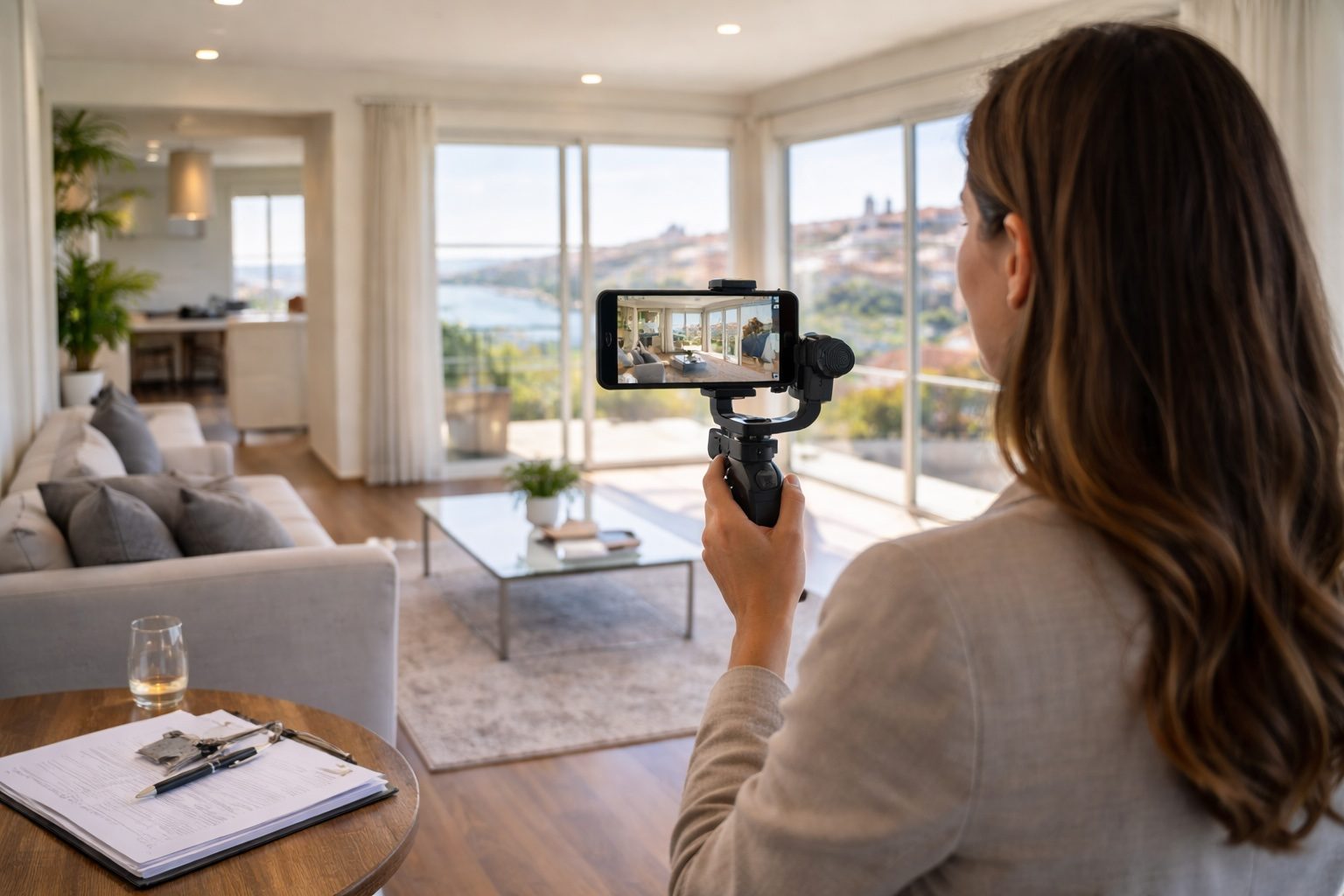
The process uses video viewings (or in-person visits by your local representative on your behalf), digital document handling for due diligence, legal representation under Power of Attorney for contracts, and remote banking setup where possible. Done properly, it is smooth, safe, and increasingly common. Done carelessly, it is one of the fastest ways to end up owning the wrong property. This guide explains how to do it properly.
Why remote buying has become common
International buyers don’t necessarily want to make multiple scouting trips — especially when balancing careers, families, or lives on another continent. A week of house-hunting in Portugal sounds romantic until you try to schedule it against work, school holidays, and the reality that the right property may come on the market the month after you fly home. Remote buying solves that tension by decoupling the transaction from the travel.
Most of our remote clients fall into one of these situations:
- Securing a home before relocating. They’ve decided to move, they know the region, and they don’t want to arrive into short-term rentals for six months while they search.
- Buying an investment property. For rental yield or capital growth, the emotional pull of a property matters less than its numbers. Video walkthroughs and due diligence reports are enough.
- Acting when timing is right. A favourable exchange rate, a market dip, or a specific property appearing can justify buying now rather than after the next available trip.
- Avoiding repeated travel costs. For buyers on other continents, three or four exploratory trips can add up to the cost of a buyer’s agent fee many times over.
- Buying a second home for future use. Holiday homes that will be used a handful of weeks per year don’t justify the same visit-intensive search as a primary residence.
None of these people are buying blind — they’re buying with local representation on the ground doing the work they would otherwise do themselves on a scouting trip. The difference is professional eyes, not fewer eyes.
Not sure which route applies to you? Portugal Compass points you to it in a couple of minutes — find your route →
What can be done remotely — and what still helps in person
The plain short answer: almost the entire transaction can be completed from abroad. Here’s the at-a-glance breakdown.
| Stage | Can be done remotely? |
|---|---|
| Defining goals and budget | Yes — fully |
| Property search and shortlisting | Yes — fully |
| Live video viewings | Yes — standard practice |
| In-person property inspection (on your behalf) | Yes — via buyer’s agent |
| Getting a Portuguese NIF number | Yes — via tax representative |
| Opening a Portuguese bank account | Sometimes — depends on bank and nationality |
| Offer and negotiation | Yes — fully |
| Legal due diligence | Yes — handled by your lawyer |
| Signing the CPCV (promissory contract) | Yes — via POA or remote signing |
| Signing the final deed (Escritura) | Yes — via Power of Attorney |
| Utility setup and registration | Yes — via lawyer or agent |
| Final area selection and neighbourhood feel | Helpful in person, not required |
What usually benefits from being in person — though is never strictly required — is the stage before you pick a property: getting a feel for neighbourhoods, comparing the atmosphere of different districts, sensing lifestyle fit. If you already know your region well, or if you’re buying primarily on numbers, that step may not be needed at all. If you’re choosing between, say, central Lisbon and a quieter part of the Silver Coast for a relocation, one exploratory trip early on can save you a lot of second-guessing later.
The real risks (and how to manage them)
We would not be doing our job if we pretended remote buying had no risks. It does. Distance removes context — and context is where most good and bad property decisions are actually made. The specific risks to be aware of:
1. Falling in love with photographs
Wide-angle lenses make rooms look larger. Carefully staged listings hide clutter. Late-afternoon light flatters almost any apartment. Photographs systematically overstate properties, and from 6,000 kilometres away you have no corrective reality check. The fix is simple in principle: before you commit, someone you trust walks through the property in person, on video, showing you the things photographs cannot — ceiling heights, sound, smell, the view from every window, the state of the communal areas, the feel of the building.
2. Missing micro-location issues
In Portugal, micro-location matters enormously. A single street can change character between blocks. The quiet square in the photograph may sit above a 24-hour bar. The sunny terrace may be in shadow by October. The charming street may be a tourist thoroughfare in summer. The “5 minutes from the beach” may include a steep unserved hill that becomes impassable in rain. None of this appears on a listing site. All of it is obvious to someone standing on the street.
3. Assuming all online listings are current
Portuguese property listings frequently stay online after properties are sold or withdrawn, and some are priced aspirationally rather than realistically. Buyers searching from abroad often end up negotiating for properties that are no longer actually available, or using stale price data as their benchmark. Current market context from someone actively working in the region removes this blind spot.
4. Weak legal checks
This is the risk with the biggest downside. Legal due diligence in Portugal is not a formality — it verifies current ownership, absence of liens and debts, correct registration, licensing, and whether what physically exists on site matches what’s on paper. Discrepancies between registered and built areas are surprisingly common in older Portuguese buildings, and they can block a future resale. Cutting corners here because “the listing looks clean” is how remote buyers end up with expensive problems. Budget for a proper lawyer — it is the single best euro you spend in the whole process.
5. Overpaying without local market context
Remote buyers often focus on a property’s features (three bedrooms, sea view, renovated kitchen) rather than its market position (is it fairly priced for its street, building, condition, and current market?). Without ground-level pricing data, it’s easy to accept an asking price that a local buyer would immediately negotiate against. The gap between “what you could pay” and “what you should pay” is often 5–15%, which on a half-million-euro property is not trivial.
Distance is not the problem. Buying blind is. With good representation on the ground, remote purchases can be as safe and well-informed as any in-person transaction — sometimes more so, because the process forces structure and documentation at every step.
How Power of Attorney works
Many foreign buyers complete their purchases using a Power of Attorney (POA). This is a legal document that authorises a representative — typically your lawyer — to sign specific documents on your behalf. In a property purchase, a properly drafted POA allows them to sign the promissory contract (CPCV), the final deed, and related paperwork without you needing to fly in for each stage.
The mechanics are straightforward but exact:
- The POA is drafted to cover the specific scope required (not a general unlimited power — that’s a mistake).
- You sign it in front of a notary in your country of residence.
- Depending on where you are, it is either apostilled (countries in the Hague Convention) or consularised at a Portuguese consulate.
- It is then translated into Portuguese by a certified translator and used in Portugal for the transaction.
Important: A POA is a significant legal instrument. Always take independent legal advice on its scope and wording before signing. A well-drafted POA is narrow, time-limited where possible, and specific to the transaction at hand. Your own lawyer — not the seller’s anyone — should draft or review it.
Properly executed, a POA enables a completely remote closing: your lawyer attends the final deed appointment at the notary in Portugal, signs on your behalf, and the property registers into your name. The first time you see your new home in person can be when you arrive with your suitcase. Drafting, notarising and apostilling the POA itself adds days or weeks to the overall purchase schedule — our timeline guide covers how the timeline shifts when you’re buying remotely alongside the standard cadence.
Does remote buying work for Airbnb & investment buyers?
Often, yes — and for many investment buyers remote purchase is the default rather than the exception. If your focus is on numbers — rental yield, location performance, demand profile, future resale — the emotional pull of walking through a property matters far less than the data underneath it. Good investment decisions are made from spreadsheets and due diligence reports, not from the feeling of morning light in a kitchen.
That said, one critical warning applies specifically to investment buyers: not every property in Portugal can automatically operate as a short-term rental. Short-term rentals require an Alojamento Local (AL) licence, and whether you can obtain one depends on the municipality, the building, the apartment, and the moment you apply. Large parts of central Lisbon and Porto have moratoriums or containment zones that prevent new AL licences in residential buildings. Buying a property remotely expecting to Airbnb it, without first confirming AL eligibility, is one of the most expensive mistakes we see — easily a year of projected income lost. Your buyer’s agent and lawyer must verify AL status during due diligence, not after the purchase completes.
Lisbon, Porto, Algarve: where remote buying works best
Lisbon works well for remote buyers seeking capital-city exposure, premium demand, and established international appeal. The rental market is mature, the expat infrastructure is deep, and pricing benchmarks are well-documented. The main challenge is pace: well-priced properties move quickly, and remote buyers need to be ready to act without multiple rounds of reflection.
Porto is often attractive for remote buyers seeking character, urban investment value, and better price per square metre than Lisbon. The market is less saturated and the city itself has matured significantly in recent years. Remote buying here works especially well for investors focused on short-term rental (in licensed areas) or long-term rental to the growing professional population.
The Algarve is popular with leisure and lifestyle buyers. Remote buying works well here provided you’re clear about which Algarve: the Golden Triangle, the central Algarve towns, and the quieter west and east all have different pricing, demand, and rental profiles. “The Algarve” as a single market is a myth.
Aveiro, Coimbra, and Setúbal offer interesting alternatives for buyers willing to go slightly off the obvious metros. Remote buying in these markets requires extra care on liquidity and resale — they’re less transparent than Lisbon or Porto — but the value proposition can be strong for the right buyer.
Why independent representation matters more when you’re remote
If you take one thing from this article, take this: in Portugal, the vast majority of estate agents represent the seller, not the buyer. Their incentive is to close the transaction in favour of the party paying their commission. For an in-person buyer who can feel out properties and second-guess advice on their own feet, that’s a manageable dynamic. For a remote buyer without ground-level context, it’s a vulnerability.
An independent buyer’s agent represents you and only you. That changes what you get:
- Market insights that account for your situation, not the seller’s.
- Strategy refinement — the willingness to tell you a property is wrong for your goals, even if it means losing a commission.
- In-person visits to shortlisted properties on your behalf, with candid video walkthroughs.
- Identification of concerns that don’t appear online: building condition, neighbour issues, orientation, street-level realities.
- Negotiation conducted by someone actually trying to get you the best deal.
- Coordination with your lawyer, mortgage broker, and any other professionals so nothing falls between the cracks.
- The experience to spot expensive mistakes before they happen.
We’re naturally biased here — this is what we do. But we’d give the same advice if we didn’t: remote buying without independent local representation is the category of risk most likely to produce a regrettable purchase. The cost of a buyer’s agent is almost always a small fraction of the purchase price, and usually pays for itself in the negotiation alone. For a fuller look at what buyer’s agents actually do in Portugal — and a clear breakdown of who does and doesn’t need one — our guide to why foreign buyers use a buyer’s agent in Portugal covers it directly.
Is remote buying right for you?
For many buyers, yes — especially if you’re purchasing for investment, trying to secure your future home before relocating, already know your preferred region, or want to move quickly when opportunities arise.
For others, one early visit can still be valuable — particularly if you’re undecided between regions, buying for lifestyle where the feel of a place matters more than its numbers, or simply want to anchor the rest of the process in a physical experience of Portugal. This is a personal call, not a technical one.
What matters most is not whether you’re physically present at every stage. It’s whether the right people are protecting your interests on the ground. With good local representation and clean legal work, a fully remote purchase in Portugal in 2026 is entirely achievable — and for the right buyer, often the better way to do it.
If you’re thinking about buying in Portugal from abroad and want to understand what the process could look like for your specific situation, we’d be happy to walk you through it. You can also read our complete 2026 guide to buying property in Portugal as a foreigner for the full picture of the process, costs, and common mistakes.